
1910: A Night at the Parlor Piano
The winter wind had barely let up as I stepped off the trolley on West 82nd Street, collar turned up, gloves thin from wear. The streetlamps glowed like halos in the mist. It was 1910, and I was 17, restless, and certain that music could change the world—or at least change me.
I arrived at the Blakelys’ brownstone just past eight. Their parlor, as always, was warm with the smell of beeswax and cigar smoke. Mrs. Blakely greeted me with a flutter of lace at her wrist and ushered me into the room where the upright piano stood, its ivories slightly yellowed but beautifully tuned. Someone was already playing—a nimble version of Scott Joplin’s “Maple Leaf Rag,” though a bit too fast, as if the pianist were racing the rhythm rather than dancing with it.
I smiled. Ragtime had swept through New York like a fever. Young people couldn’t get enough of its syncopated joy. It felt like rebellion in four-four time. Joplin was the name on everyone’s lips, even here in the parlor world of lace curtains and embroidered armchairs.
But not all shared the excitement. I noticed Mr. Blakely’s disapproving frown from his wingback chair, where he preferred Brahms and Schumann. “Real music,” he often muttered. He hadn’t yet come to terms with the fact that music, like society, was changing—and fast.
After some cake and tea, it was my turn at the piano. I slid onto the bench, cracked my knuckles, and began a piece I had memorized from a borrowed score: Debussy’s “Clair de Lune.” The room quieted. Even the gramophone in the corner—earlier spinning some sentimental Tin Pan Alley number—seemed to pause its creaking.
The notes shimmered like moonlight across still water. I had never been to France, never seen the Seine or heard a real orchestra, but Debussy made me believe I had. When the last chord faded, Mrs. Blakely dabbed her eyes with a handkerchief. Mr. Blakely nodded approvingly. “Now that is music,” he declared.
But I wasn’t sure anymore. I loved the elegance of Debussy, yes—but I also loved the heat of ragtime, the bawdy songs you could hear drifting from saloons near the docks, the new recordings you could buy for thirty cents and play at home on a Victor Victrola. I loved the whisper that something wilder was coming—something we didn’t yet have a name for.
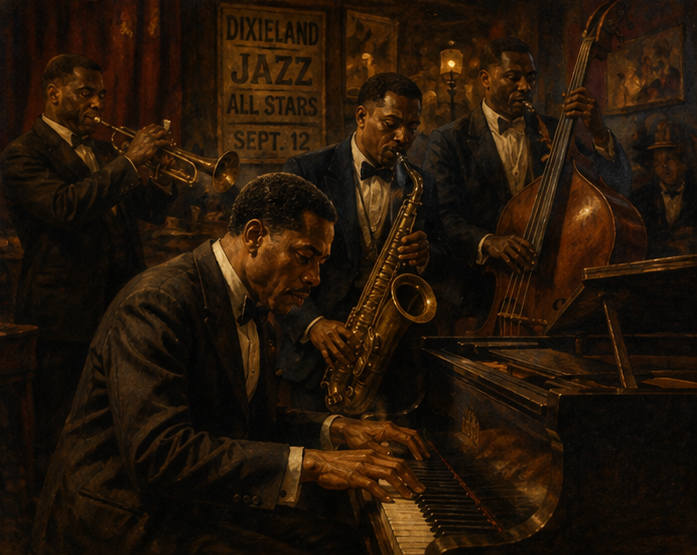
After I played, a young man named Harris took over. He was from New Orleans and carried himself like someone who knew secrets. He played a tune I didn’t recognize, something bluesy, loose, half-improvised. Mr. Blakely grunted and left the room. The rest of us leaned closer, as if drawn by a sound from the future.
It was 1910. A new century had just begun. And in that parlor—beneath gaslight and shadow, with lace sleeves brushing teacups and music sparking from every corner—I felt it: the old world melting away, one note at a time.

Comments