
1910: The Boy with the Brass Horn
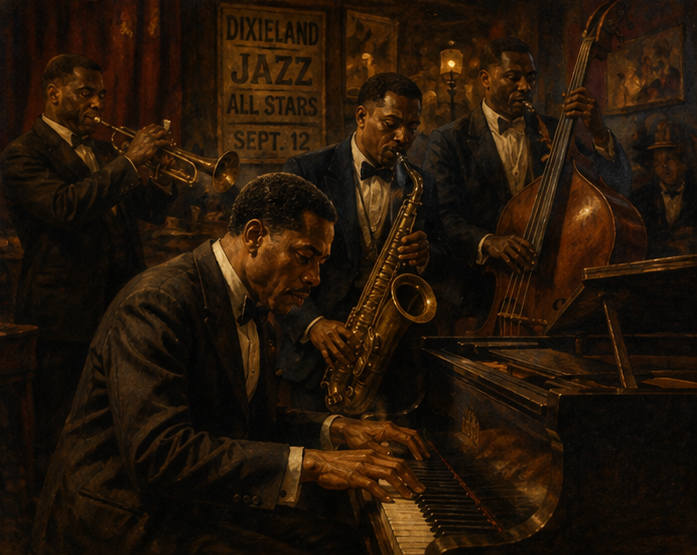
I was 16 when I found the saxophone—well, more like it found me. My brother had joined the Navy and left behind a battered case in our attic in New Orleans. I opened it one humid afternoon in July. Inside was a curved brass horn, dulled but still proud, like something from another world.
I had only ever seen a saxophone once before—in a parade that came down Canal Street, led by a band of colored men in white suits and bowler hats. Their sax man was tall, slick, and full of fire. He played like the devil was chasing him and the angels were trying to keep up. I’d never heard anything like it. The piano was sweet, and the cornet was sharp, but the sax? The sax sang.
I taught myself to play in the alley behind our house, blowing into the horn while my little sister clapped along with a tin spoon. The neighbors complained, sure. But sometimes—just sometimes—I could see old Miss Delores from two houses over tapping her slipper against the porch.
By autumn, I was playing Friday nights with the Baptiste Brothers Band at Miss Claudine’s café. We weren’t famous—barely even paid—but the music was alive. Mostly ragtime and marches, sometimes blues when the owner wasn’t listening. And me, a boy with no training and too much nerve, weaving my sax into it all like I belonged there.
The saxophone wasn’t respectable back then. Not like the piano or violin. Some called it vulgar—too raw, too full of sin. But that was what I loved. It wasn’t polite. It didn’t whisper. It shouted. It told the truth.
One night, a stranger came into the café. He wore a straw boater and leaned heavy on a cane. Watched us through the smoke, didn’t touch his drink. After the last set, he walked over to me and said, “You ever play with a real jazz band, son?”
I didn’t know the word. “Jazz?” I asked.
He smiled like he’d just seen the future. “You will.”
I didn’t sleep that night. I sat by the window, saxophone in my lap, watching the moon through the lace curtain, wondering what was coming. I could feel it in my bones—something was about to shift. Music wasn’t just notes on paper anymore. It was rebellion. It was soul. It was life, messy and loud and honest.
It was 1910. Nobody had records yet, not in our neighborhood. The phonograph was a dream, the radio a rumor. But in the smoky corners of cafés, on the back porches of shotguns, in the streets after funerals and weddings, a new sound was being born.
And somewhere in the middle of it, was me—the boy with the brass horn, trying to catch fire in a song.


Comments