
1920: Harlem, and the Sound of Home

When I got off the train at Grand Central in the spring of 1920, New York hit me like a bass drum—loud, fast, and impossible to ignore. I’d just come back from Paris, and my French was still sharper than my English. But the moment I set foot in Harlem, I felt it deep in my chest: I was home.
Harlem wasn’t what it had been when I left. It was more—bigger, louder, alive in a way that no city on earth could match. Black folks were coming up from Georgia, Mississippi, Louisiana—pouring into the city by the thousands. They brought church songs, blues, brass, banjos, and babies. And on Lenox Avenue, it all melted together into something new.
They called it the Harlem Renaissance. I didn’t care what they called it. All I knew was: the nights were longer now, and the music didn’t stop when the sun came up.
I found work almost instantly. Not because I was lucky—but because I had two things going for me: I could read music, and I could swing like hell. The gigs were everywhere. Rent parties in brownstones, dance halls on 135th, roadhouses on the edge of town. If you could keep time and carry heat, you worked.
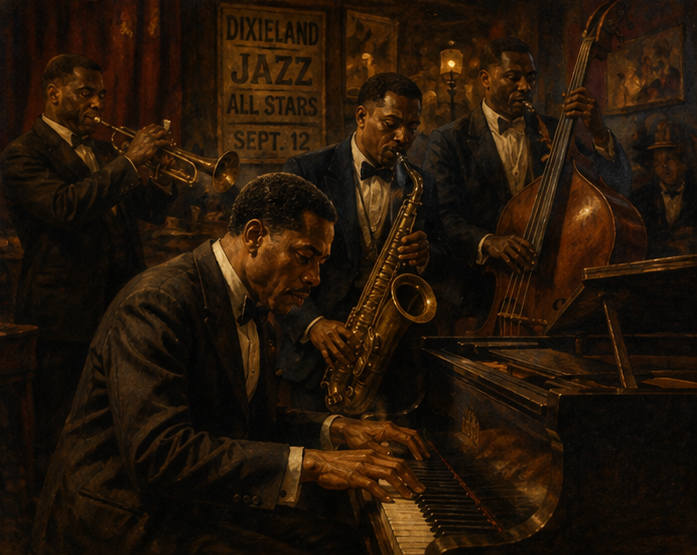
My first steady job was at a spot called The Palm. A speakeasy hidden behind a bakery. Password at the door. Candles on the tables. Real piano, real drinks, real danger. Half the customers were rich white folks from downtown, chasing the edge of something they didn’t understand. The other half were locals, sharp-dressed and proud, singing along to every tune we threw at them.
That’s where I met Duke. Not the Duke—he hadn’t made it big yet—but Duke Jenkins, a piano man from South Carolina with a left hand like thunder and a right hand that could write poetry without ink. He played with that thing you can’t teach—feel. Together, we built a band that packed the place every Saturday night until the cops shut it down.
Jazz was changing. Getting sleeker. Faster. We weren’t just playing rags anymore—we were improvising, stretching time, turning simple tunes into cathedrals of sound. The young cats called it “hot.” I called it coming alive.
One night, a kid named Louis Armstrong passed through on his way up from New Orleans. He had a horn that made the air crackle. Said he was heading to Chicago, but wanted to see what Harlem felt like. We jammed in a basement ’til dawn. He blew like he’d been sent from heaven with a trumpet and a warning. I told him, “Go north, kid—but you’ll be back.”
The city was a furnace, and we were the fire. Everyone wanted jazz. They wanted it loud, and wild, and new. And we gave it to them. Every night, from dusk to daybreak.
It was 1920. The war was over, Prohibition was just getting started, and Harlem? Harlem was the heartbeat of the world. And me? I was just one more sax man chasing something sacred in every solo.

Comments